




The IELTS (International English Language Testing System) is a globally recognized test designed to measure English language proficiency for individuals aiming to study, work, or migrate to English-speaking countries. Whether you’re dreaming of attending a top university, securing a job abroad, or obtaining a visa, a strong IELTS score is often a critical requirement. This test evaluates four key skills: Listening, Reading, Writing, and Speaking, providing a comprehensive assessment of your ability to communicate effectively in academic and professional settings.
This article dives deep into everything you need to know about the IELTS exam: its format, costs, scoring, preparation strategies, and why thorough preparation is essential for success. We’ll also share expert tips, sample questions, and resources to help you achieve your target band score (6.5–8.0 for most universities and visas). Plus, we’ll explain how Ultimate Education’s IELTS preparation courses can guide you to success. Read on to unlock your path to studying or working abroad!
Why Is IELTS Important?
The IELTS test is a gateway to opportunities in countries like the UK, Australia, Canada, New Zealand, and the USA. Accepted by over 11,000 organizations worldwide, including universities, employers, and immigration authorities, IELTS is a trusted measure of English proficiency. A good IELTS score (typically 6.5 or higher) can:
- Secure admission to top universities like Oxford, Harvard, or the University of Melbourne.
- Meet visa requirements for study, work, or permanent residency.
- Enhance your resume for global job opportunities in industries like healthcare, engineering, or IT.
- Boost your confidence in using English in academic and professional environments.
With two versions—Academic (for study) and General Training (for work or migration)—IELTS caters to diverse goals. Whether you’re aiming for a scholarship, a job in London, or residency in Canada, understanding the test’s structure and preparing effectively are key to achieving your desired band score.
What Is the Cost of the IELTS Exam?
The cost of the IELTS exam varies by country and test provider, typically ranging from $200 to $250 USD globally. In some regions, prices may be slightly higher due to currency exchange rates or additional administrative fees. Major test providers include the British Council, IDP Education, and Cambridge Assessment English, each offering testing centers in cities worldwide.
In Indonesia, for example, the cost is approximately IDR 3,000,000–3,500,000, depending on the test center and location (Jakarta, Surabaya, Bandung, etc.). Additional costs may include rescheduling fees (around $50) or score reporting to multiple institutions (typically $20 per report). To prepare effectively, consider investing in a guidebook, official practice materials, or an IELTS preparation course to maximize your score and avoid retaking the test.
What Is the Format of the IELTS Exam?
The IELTS exam is structured to assess your English proficiency across four sections: Listening, Reading, Writing, and Speaking. The total test duration is approximately 2 hours and 45 minutes, with Listening, Reading, and Writing conducted on the same day, and Speaking scheduled separately (often within a week). Here’s a detailed breakdown:
1. Listening (30 minutes, 40 questions, Band 0–9)
The Listening section tests your ability to understand spoken English in various contexts, such as conversations, lectures, or monologues. It consists of four recordings, each followed by 10 questions. Types include multiple-choice, matching, and sentence completion.
- Structure: Four recordings (e.g., a casual conversation, a university lecture, a group discussion).
- Tips: Practice note-taking while listening to podcasts like BBC Learning English or TED Talks. Focus on keywords and transitions (e.g., “however,” “in addition”). Use official IELTS practice tests to familiarize yourself with accents (British, Australian, American).
2. Reading (60 minutes, 40 questions, Band 0–9)
The Reading section evaluates your ability to comprehend academic or general texts. It includes three passages (Academic) or five shorter texts (General Training), with questions like multiple-choice, true/false/not given, and matching headings.
- Structure: Passages cover topics like science, history, or social issues, each around 700–900 words.
- Tips: Practice skimming for main ideas and scanning for specific details. Read articles from sources like The Guardian or National Geographic to build speed and vocabulary.
3. Writing (60 minutes, 2 tasks, Band 0–9)
The Writing section is often considered the most challenging, requiring you to complete two tasks within 60 minutes. Task 1 (150 words) involves describing visual data (Academic) or writing a letter (General Training), while Task 2 (250 words) is an essay on a given topic.
- Structure: Task 1 (20 minutes, e.g., describe a chart or graph); Task 2 (40 minutes, e.g., argumentative essay).
- Tips: Use a clear structure (introduction, body paragraphs, conclusion). Practice with sample prompts from IELTS.org and use tools like Grammarly to check grammar and style.
4. Speaking (11–14 minutes, 3 parts, Band 0–9)
The Speaking section is a face-to-face interview assessing fluency, coherence, pronunciation, and vocabulary. It includes three parts: an introduction, a short speech, and a discussion.
- Structure: Part 1 (personal questions, 4–5 minutes); Part 2 (2-minute speech on a topic); Part 3 (discussion, 4–5 minutes).
- Tips: Practice with a partner or tutor to build confidence. Record your answers to analyze fluency. Use varied vocabulary and avoid memorizing responses.
Why Is the Writing Section the Most Difficult?

The IELTS Writing section is often cited as the most challenging due to its time constraints and the need for clear, coherent, and accurate English. Studies indicate that over 50% of IELTS candidates find Writing the hardest section, as it requires:
- Task 1: Summarizing visual data (e.g., graphs, charts) or writing a formal/informal letter in 150 words within 20 minutes.
- Task 2: Writing a 250-word essay with a clear argument, examples, and conclusion within 40 minutes.
Key challenges include time management, structuring ideas logically, and using a wide range of vocabulary and grammar accurately. To succeed, practice writing essays daily, use sample prompts from official IELTS resources, and seek feedback from a tutor at Ultimate Education.
Assessment Criteria for IELTS Writing
The Writing section is evaluated based on four criteria, each contributing to your band score:
- Task Achievement: How well you address the task and develop ideas (e.g., summarizing data accurately in Task 1).
- Coherence and Cohesion: The logical organization and flow of your writing, using linking words like “however” or “therefore.”
- Lexical Resource: The range and accuracy of your vocabulary.
- Grammatical Range and Accuracy: The use of varied sentence structures and correct grammar, including tenses.
To assess your writing skills and identify areas for improvement, take the free IELTS Writing Test offered by Ultimate Education. This diagnostic tool provides personalized feedback to help you target a band score of 6.5 or higher.
IELTS Writing Task 1: Sample Question and Answer
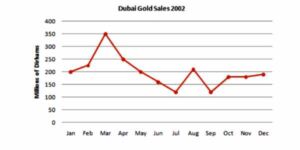
Question: The diagram illustrates how gold sales in Dubai changed over a period of 12 months.
Answer: The diagram illustrates the fluctuations in gold sales in Dubai throughout 2002. Overall, gold sales remained relatively stable by the end of the year despite significant variations. The highest sales occurred in March, while the lowest were in July and September.
In January 2002, sales stood at 200 million dirhams, rising slightly to 225 million in February. March saw a peak, with sales reaching approximately 350 million dirhams. However, a sharp decline followed, dropping to just over 100 million dirhams in July. August marked a recovery to 200 million dirhams, but sales fell again to 100 million in September. October saw a modest increase to 200 million dirhams, stabilizing over the final two months.
Tip: For Task 1, focus on key trends, use comparative language (e.g., “higher than,” “dropped significantly”), and avoid personal opinions. Practice with similar prompts to improve data description skills.
IELTS Writing Task 2: Sample Question and Answer
Question
Some people believe that history is one of the most important academic disciplines, while others argue that science and technology are more crucial in the modern world. Discuss both views and give your opinion.
Answer
Education forms the backbone of modern society, requiring a balanced curriculum to equip students with diverse skills. The debate over the importance of history versus science and technology is ongoing, with valid arguments on both sides.
Proponents of history emphasize its role in understanding the past. Studying historical events, cultures, and ideas helps students learn from past mistakes and appreciate societal development. For example, analyzing historical conflicts fosters critical thinking and empathy, skills essential for informed decision-making. History also preserves cultural heritage, enabling students to connect with their roots and understand global perspectives.
Conversely, advocates for science and technology highlight their relevance in today’s fast-paced world. Technological advancements drive progress in communication, healthcare, and transportation, making these fields critical for future careers. For instance, skills in coding or data analysis are in high demand, and scientific knowledge supports innovations like renewable energy. Preparing students for a tech-driven workforce is thus a priority.
In my opinion, both history and science/technology are vital. History provides context and critical thinking skills, while science and technology equip students for future challenges. A balanced curriculum ensures students gain a holistic education, combining historical insight with practical skills.
In conclusion, both disciplines are essential for a well-rounded education. History fosters understanding and critical thinking, while science and technology prepare students for modern demands. Striking a balance between these subjects is key to nurturing versatile, informed individuals.
Read Also: What Is The Minimum IELTS Score Required To Study Abroad?
IELTS Scoring and Band Requirements
IELTS scores range from 0 to 9 for each section, with an overall band score calculated as the average. Common requirements include:
- Universities: Most top universities (e.g., Oxford, UBC) require 6.5–7.0 overall, with no section below 6.0.
- Visas: Countries like Australia and Canada often require 6.0–7.0 for study or work visas.
- Scholarships: Competitive programs like Chevening or Australia Awards may demand 7.0 or higher.
Scores are valid for two years, and results are available within 3–5 days (computer-based) or 13 days (paper-based). To compare, an IELTS band of 6.5 is roughly equivalent to a TOEFL iBT score of 79–90. Check specific requirements for your target institution or visa on IELTS.org.
Top Strategies for IELTS Preparation
Achieving a high IELTS band score requires strategic preparation. Here are 10 proven tips to boost your performance across all sections:
- Understand the test format: Familiarize yourself with question types and timing using official IELTS practice materials.
- Join a preparation course: Enroll in an IELTS preparation course at Ultimate Education for expert guidance and personalized feedback.
- Improve Listening skills: Listen to English podcasts (e.g., “All Ears English”) and practice note-taking.
- Enhance Reading skills: Read academic articles from sources like BBC or The Economist to build speed and comprehension.
- Master Writing: Practice essays with clear structures (introduction, body, conclusion). Use sample prompts from IELTS.org.
- Boost Speaking fluency: Practice with a native speaker via platforms like italki or record answers for self-review.
- Expand vocabulary: Learn academic words using the Academic Word List (AWL) or apps like Quizlet.
- Simulate test conditions: Take full-length practice tests under timed conditions to build stamina.
- Manage time effectively: Allocate time wisely (e.g., 20 minutes for Writing Task 1, 40 for Task 2).
- Seek feedback: Work with a tutor to identify weaknesses and refine your skills.
Common Challenges and How to Overcome Them
IELTS candidates often face challenges that can hinder their performance. Here’s how to address them:
- Time pressure: Practice with a timer to improve speed, especially in Writing and Reading.
- Weak vocabulary: Read widely and use flashcards to learn synonyms and academic terms.
- Speaking anxiety: Practice daily conversations and record yourself to build confidence.
- Poor coherence in Writing: Use essay templates and linking words to improve structure.
- Difficulty with accents: Expose yourself to various English accents through movies, podcasts, or YouTube.
Free Resources for IELTS Preparation
In addition to paid courses, several free resources can help you prepare:
- IELTS.org: Offers free sample questions and practice tests at IELTS.org.
- YouTube: Channels like IELTS Liz and English with Emma provide tips and sample answers.
- Apps: Download IELTS Prep by British Council or Magoosh for practice questions.
- Websites: Sites like IELTS Buddy and Road to IELTS offer free guides and mock tests.
While free resources are valuable, a structured course from Ultimate Education provides tailored feedback and strategies to maximize your score.
FAQ: Common IELTS Questions
What’s the difference between IELTS Academic and General Training?
Academic is for university admissions, while General Training is for work or migration. The Reading and Writing sections differ, with Academic focusing on academic texts and General on practical scenarios.
How long is the IELTS score valid?
Scores are valid for two years from the test date.
Can I retake the IELTS if I don’t get my desired score?
Yes, you can retake the test as many times as needed, with no minimum waiting period.
What’s the minimum IELTS score for studying abroad?
Most universities require 6.5–7.0 overall, with no band below 6.0. Check specific requirements at Ultimate Education’s guide.
How can I prepare for the Speaking section?
Practice with a tutor, record your answers, and use varied vocabulary. Join a course at Ultimate Education for mock interviews.
The Importance of Thorough Preparation for the IELTS Test
The IELTS test is a critical step for achieving your academic and professional goals in English-speaking countries. Thorough preparation is essential to secure a high band score, as it:
- Improves your familiarity with the test format and question types.
- Enhances your English skills across listening, reading, writing, and speaking.
- Boosts confidence and reduces test-day anxiety.
- Increases your chances of meeting university, visa, or job requirements.
One of the most effective ways to prepare is by enrolling in an IELTS preparation course at Ultimate Education. Our courses offer:
- Expert instructors: Experienced teachers who understand IELTS scoring and strategies.
- Tailored materials: Practice tests and exercises designed to target your weaknesses.
- Mock tests: Simulate real test conditions to build confidence.
- Personalized feedback: Detailed advice to improve your performance in each section.
- Flexible options: Choose online or in-person classes to suit your schedule.
Don’t leave your IELTS success to chance! Join Ultimate Education to achieve your target band score and unlock your dreams of studying or working abroad.
Ready to ace the IELTS? Start your preparation with Ultimate Education’s expert courses and take the first step toward your global future!
